Rákosrendező Masterplan, Budapest


2026 International Competition Winner
Cient: Budapest Capital Asset Management Centre on behalf of the Municipality of Budapest
Team: Coldefy, Cityförster, Marko & Placemakers, Spora Architects, Treibhaus Landscape
Specialist sub consultants: Buro Happold
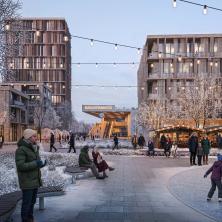
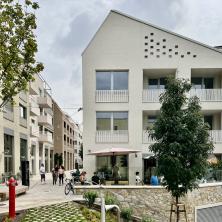
Rákosrendező in Budapest is one of the most significant urban transformation projects in the region. Covering 244 hectares, the site represents a unique opportunity to redefine a largely abandoned railway yard into a vibrant, sustainable, and inclusive new district. Our proposal sets a clear direction for the future of the area, envisioning a highly liveable neighbourhood with approximately 10,000 homes, generous green spaces, and a strong public realm network. Commissioned by the Budapest Capital Asset Management Centre on behalf of the Municipality of Budapest, the competition aims to establish a comprehensive masterplan for the long-term regeneration of this strategic brownfield site.
New Rákosrendező is conceived as a landscape-led transformation that reconnects the city, restores ecological systems, and balances urban density with generous public space. The project reimagines a vast former railway yard as a resilient, people-centred district—turning fragmentation into continuity and isolation into urban life.
Located at a strategic intersection of Budapest’s historic and future growth, the site represents one of the city’s most significant development opportunities. Rather than simply filling a gap, the proposal establishes a new benchmark for contemporary urbanism—compact, nature-oriented, and socially inclusive—while strengthening the city from within and limiting outward expansion.
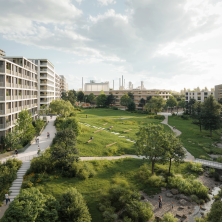
The masterplan builds on the site’s existing qualities. Over time, spontaneous vegetation and wildlife have reclaimed the former industrial landscape, creating a unique post-industrial ecosystem. Instead of erasing this condition, the project amplifies it: restoring the Rákos Stream, transforming woodlands into parks, remediating soils, and reusing railway structures and heritage elements as part of a new identity.
A strong landscape framework structures the district, with a continuous network of parks and open spaces forming its backbone. At its core, the revitalised stream acts as an ecological corridor and central public space, while a complementary cultural axis reactivates preserved buildings and connects a series of neighbourhoods into a coherent whole.
The development prioritises sustainable mobility through a people-first approach, encouraging walking, cycling, and public transport while reducing reliance on private cars. Flexible public spaces, mixed housing, and inclusive urban design support long-term adaptability and everyday life.
New Rákosrendező is envisioned as a shared habitat—where landscape, infrastructure, and community coexist—offering a forward-looking model for sustainable urban transformation in Budapest.